

Knowledge base
Find out why it's really important to preserve stem cells

Need more information?
You will always find more comprehensive information on the pages of the Polish Stem Cell Bank
Learn moreBasic Information
Umbilical cord blood, also known as “blood of the placenta,” is the blood that remains in the umbilical cord and placenta after birth. It is a valuable source of genetically unique stem cells. Until recently, it was treated as “waste” and disposed of along with the placenta and umbilical cord.
Yes, if medically justified and there is sufficient tissue compatibility between donor and recipient. There is a 25% probability that the tissue antigens of siblings are fully compatible.
Yes. Studies indicate that stem cells from cord blood are more primary, less targeted, and have higher proliferative dynamics compared to stem cells from adult bone marrow or peripheral blood. Freezing these cells prevents aging and injury that occurs later. They generally do not contain cancer cells that form in later years due to environmental factors.
Matching donor and recipient marrow is difficult because a “full match” is typically required. Stem cells from cord blood have less immunological maturity, resulting in fewer complications, lower risk of rejection, and a reduced “graft versus host” reaction. They can even be used with incomplete compatibility. Additionally, cord blood stem cells are readily available and less likely to cause complications such as Graft versus Host Disease (GvHD).
More than 35,000 cord blood transplants have been performed worldwide. Cord blood stem cells have shown potential to transform into other cell types, including muscle or nerve cells. Research into their regenerative properties continues, with potential uses for conditions like Alzheimer’s, diabetes, heart disease, muscular dystrophy, Parkinson’s, and spinal cord injuries.
PBKM performs tests on both the mother’s blood (9 ml collected during delivery) and the baby’s umbilical cord blood. Tests on the mother’s blood include viral and bacteriological screenings (e.g., HBs Ag, HIV, syphilis, etc.). Tests on the cord blood include leukocyte count, cell viability, and microbiological tests for bacteria and fungi.
An individual contract number and an identification number are assigned to each customer. These numbers are present on all elements of the collection kit and documentation, ensuring that there is no risk of mistaken identity.
While all hygienic protocols are followed, there is no guarantee that the collected material will not be contaminated. However, PBKM takes all necessary precautions, and the kits used are sterile and certified by the AABB (American Association of Blood Banks).
PBKM records approximately 2% infection rates among all collections. This number can vary due to the large scale of operations.
The operation of cord blood banks is regulated by several European and Polish laws and directives, including:
- Directive 2004/23/EC of the European Parliament
- Commission Directive 2006/17/EC and 2006/86/EC
- Act of July 1, 2005 on the collection, storage, and transplantation of cells, tissues, and organs.
Yes, an addendum to the contract along with an invoice adjustment will be provided.
If a family member needs the stem cells, the attending physician will contact PBKM to arrange the delivery of the biological material. Parents will also need to provide the necessary documentation and coordinate with the Customer Service Officer for the transfer of the stem cells to the appropriate hospital for treatment.
Download and storage information
“Graft-versus-host disease” consists in the fact that transplanted donor lymphocytes, responsible for stimulating immune reactions, in the recipient’s body act according to their previous “programming” and recognize cells of the recipient’s body as foreign. The destruction of recipient cells by donor lymphocytes occurs. Virtually all cells of the recipient organism are affected. The cells most vulnerable to attack are those with a short life cycle, that is, cells of the epithelium and some parenchymal organs. As a result, the symptoms of this disease are the result of epithelial damage (rashes, hives, dry and scaly skin and epithelia, for example, of the gastrointestinal tract = diarrhea). It is a severe and difficult to treat disease. After cord blood transplants, these reactions are much less severe because the stem cells present in cord blood are immunologically “naive.”
Compatibility refers to proteins called HLA system antigens, which are found on the surface of white blood cells and other body cells. They determine tissue compatibility between recipient and donor. Although a complete match would be best, studies have shown that cord blood transplants are successful even if there is not a complete match. Cord blood stem cells are less mature, more immunologically “native” in contrast to the stem cells found in bone marrow.
The first cord blood transplant was performed in 1988. Since then, more than 85,000 transplants have been performed. The possibility of collecting and storing cord blood became more available at the end of 1995. Today, thousands of parents are taking advantage of this once-in-a-lifetime opportunity.
Umbilical cord blood is collected from the umbilical cord just after the baby is born and unbuttoned. The procedure for obtaining cord blood is simple and painless, completely non-invasive and not disruptive to the course of labor.
Umbilical cord blood is collected in a collection container, which contains a preservative liquid (CPD) to prevent the blood from clotting, giving us time to get it to the laboratory and prepare it.
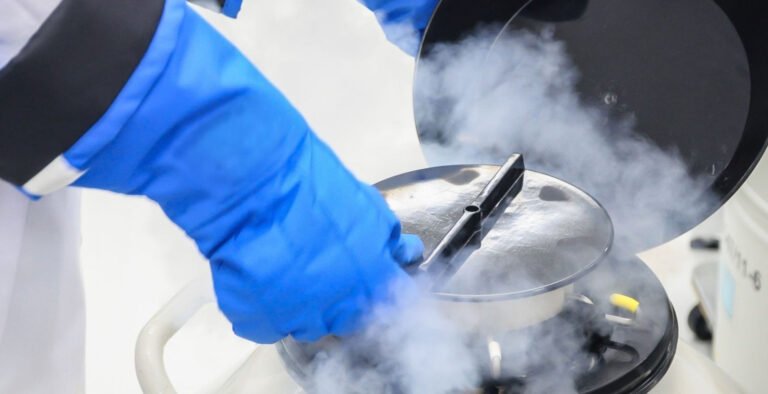
Theoretical considerations show that it is possible to store stem cells in deep-frozen conditions (at temperatures below -150°C) for hundreds of years. Practically, we have the experience of Japanese scientists who tested the viability of stem cells frozen in 1973. Their research shows that the cells they thawed show the ability to multiply and to form colonies. Current data say that cord blood cells stored for nearly 24 years have the same abilities as when storage began.
It is important to remember that childbirth is not a sterile process. Therefore, despite all due diligence and aseptic principles, it may turn out that the sample was infected. If the infection is not a threat to the quality of the collected material, then there is no contraindication to the blood being prepared, frozen and used in the future if it is needed. Some bacteria are not resistant to low temperatures, which means that they can die out during the freezing process. Nevertheless, there are also some that will survive low temperatures. In the event that a transplant is needed and the frozen material is infected, the treating physician will decide whether it can be used. Stem cells are used to treat life-threatening diseases. It is therefore difficult to compare the consequences of infecting a patient with a bacterium with the risks of not giving life-saving cells.
The initial fee, is the cost of the collection kit and the activities related to the acquisition of biological material and its transport to the laboratory, so it can be refunded only if it is returned to PBKM intact. In the case of detection of cord blood and/or placental blood infection, there is a situation of use of the collection kit, so parents will not receive a refund of the initial fee. Parents may, however, receive a partial refund of the initial fee, provided that within 10 days of receiving the results of the final qualification of the biological material, they send to PBKM a signed Declaration of Intent informing of their willingness to abandon further procedures related to the storage of infected material. If the parents abandon the storage of the material due to microorganisms, the basic fee will be refunded after deduction of the handling fee:
- PLN 300 for cord blood;
- PLN 200 for placental blood.
Both thawing and transplantation are performed under sterile hospital conditions, so the risk of contamination of the material appears to be negligible. We assume that if the transplant is performed in facilities specialized in performing transplants, all aseptic principles will be observed. This means that there should be no contact between the blood and any contamination, virus or bacteria. A stem cell transplant is performed just like a regular injection of a drug, hence, as with a standard injection, the risk of infection exists, but is minimal.
| Feature | Public bank | Family bank |
|---|---|---|
| Purpose of blood | Transplantation for an unrelated person | Transplantation for a child, his/her siblings or family |
| Blood ownership | State | Child/Parents |
| Blood collection | Midwife/doctor | Midwife/doctor |
| Storage | Nitrogen vapors/liquid nitrogen | Nitrogen vapors/liquid nitrogen |
| Costs of the service | State (Ministry of Health) | Parents/adult child |
| The cost of using a transplant clinic in Poland | Several tens of thousands of PLN | No need for additional costs |
| Utilization in Poland | Dozens of transplants | 13 transplants (all from PBKM) |
| Genetic compatibility | Necessary determination of transplantation antigens (HLA) after procurement | Compatibility for the child -100%, in the case of siblings the need to determine transplant antigens before transplantation. Probability of full compatibility – 25%. |
| Probability of using blood for the child from whom it was collected | Blood from banks not used | 1/400 |
| Likelihood of blood being used for siblings of the child from whom it was collected | Not applicable | 1/100 |
| Probability of using blood for an unrelated person | According to various sources – 1/100 to 1/500 | Not applicable |
- The probability of use is calculated over a life span of 70 years and applies to cell transplantation independent of the source.
Yes, all hospitals and midwives cooperating with PBKM are trained to maintain the principles of asepticism during collection. Each time, every care is taken when collecting cord blood to ensure that the sample is not contaminated. However, due to the fact that childbirth is not a sterile (sterile) process, infection cannot always be prevented. PBKM does not take a position when it comes to the level of knowledge of midwives and hospitals that do not cooperate with PBKM.
Umbilical cord blood can be collected at virtually any hospital in the country. The biological material is collected by properly trained personnel. This is usually a midwife working in the delivery room.
Additional information
No. Cord blood is collected only after the baby is born and cut from the umbilical cord. Collection takes about 5 minutes, is painless, easy, and safe for both mother and baby.
No. The birth takes place in the same way as if the parents had not opted for cord blood collection. Umbilical cord blood collection occurs only after the umbilical cord is cut. The decision on when to cut the umbilical cord should be made by the midwife and doctor, taking into account current medical knowledge and information on the course of pregnancy and labor, the health of the mother and child, and the preferences of the ward or reported by the mother.
No. After signing the contract, parents will receive a “collection kit” that contains all the items necessary to collect their child’s cord blood. Parents only need to remember to take the kit with them to the hospital on the day of delivery.
After collection, cord blood is placed in a collection kit, in which it is transported to our laboratory in Warsaw. Depending on the day of the week, time of day, and hospital location, PBKM selects the best form of transport. We use the following forms of cord blood transport:
- Transport by car by PBKM courier
- Transportation by car by an external courier
- Rail transport
- Air transport
- Mixed transport (car and train, plane and train)
As a result, 100% of shipments reach our laboratory within 72 hours of collection. For donations and transport from outside Poland, our collection kit is designed to keep blood safe for up to 96 hours. This was confirmed under real-world conditions during the transport of blood from Spain to Poland in 2010 when, due to a volcanic eruption, we were forced to use land transport instead of air.
In the case of cesarean section, blood is drawn immediately after the placenta is extracted. Studies show that the volumes collected in natural childbirth and cesarean delivery are comparable.
No, because it is not needed routinely. The principle of individual stem cell banking is that the donor and recipient are the same organism. Of course, if these stem cells are used for the benefit of a sibling or other family member of the child from whom they are derived, the stem cells must be tested for tissue compatibility. For this purpose, a small sample is attached to each frozen container, which is thawed if necessary and can be tested for, among other things. For tissue compatibility determination, PBKM, if necessary, sends such a sample to an external laboratory, where HLA is determined to the extent needed.
In the case of an absolute contraindication to blood banking (e.g. HIV infection), the Polish Stem Cell Bank decides to reject the sample for storage, of which the parents are informed each time. However, if the sample is not infected with a virus that absolutely disqualifies the material for freezing, the decision whether to store the infected blood belongs to our clients, as they have the sole right to make decisions about the health of their family. Our hematologists, with whom the final results of the collected material can be discussed, can assist in the decision. Each time an infection is detected, parents are informed of this fact and are urged to sign a written statement of intent confirming their agreement or disagreement with the further handling of the collected material.
There are two options for storing cord blood:
- In a family bank, such as the Polish Stem Cell Bank, for autologous or allogeneic transplants for related recipients.
- In public banks for the purpose of allogeneic transplants for unrelated recipients – then the parents relinquish rights to this blood, and the donation is altruistic. PBKM also allows such donations at selected hospitals. Public BankingInformation
Every parent has the right to choose whether to donate their child’s cord blood to a public bank or secure it for their child and family.
Because it ensures that cord blood stem cells can be used for therapeutic purposes at any time, without having to search for donors, which is a costly, time-consuming process that does not guarantee success. Early treatment of many diseases minimizes the risk of developing them and increases the chances of a complete cure.
Due to a change in the VAT law, the service of storing stem cells from cord blood is charged at 23% VAT.
An amendment to the Value Added Tax Law effective since 2011 introduced a new descriptive definition of medical services, which (according to the Finance Minister) strips stem cell storage of its VAT exemption. Given that the tax would have been a burden on PBKM’s customers, and the legitimacy of its introduction raised a number of legal doubts, PBKM challenged this interpretation, which started a lengthy court dispute with the Minister of Finance. Unfortunately, after two years of litigation, the Supreme Administrative Court upheld this unfavorable position for blood banks: CourtDecision
Yes. The procedure of collecting cord blood does not interfere with the course of labor. The collection is safe for both mom and baby. The blood is collected just after birth when the baby is already unbuttoned, and what is biologically unnecessary is taken.