
Stem Cells – What Are They?
Stem cells are primary, unspecialized cells with tremendous potential to multiply and transform into specialized cells. Due to these properties, they can be used in medicine to rebuild damaged tissues and cells. Stem cells can be found in several places, including umbilical cord blood, bone marrow, peripheral blood after pharmacological mobilization, and the umbilical cord.
Historically, bone marrow was the primary source of stem cells, especially in procedures like bone marrow transplants. However, stem cells obtained from cord blood are increasingly used for therapeutic purposes.
Stem cells are currently used to treat more than 80 serious diseases, with ongoing research exploring their potential for new conditions. They are mainly used in hematology, oncology, and neurology. Diseases treatable with stem cells include leukemia, certain cancers, hematopoietic and immune system disorders, metabolic diseases, and more. In recent years, stem cells have also been successfully used to treat conditions like autism spectrum disorder and cerebral palsy.
Stem Cells – Where Do They Come From?
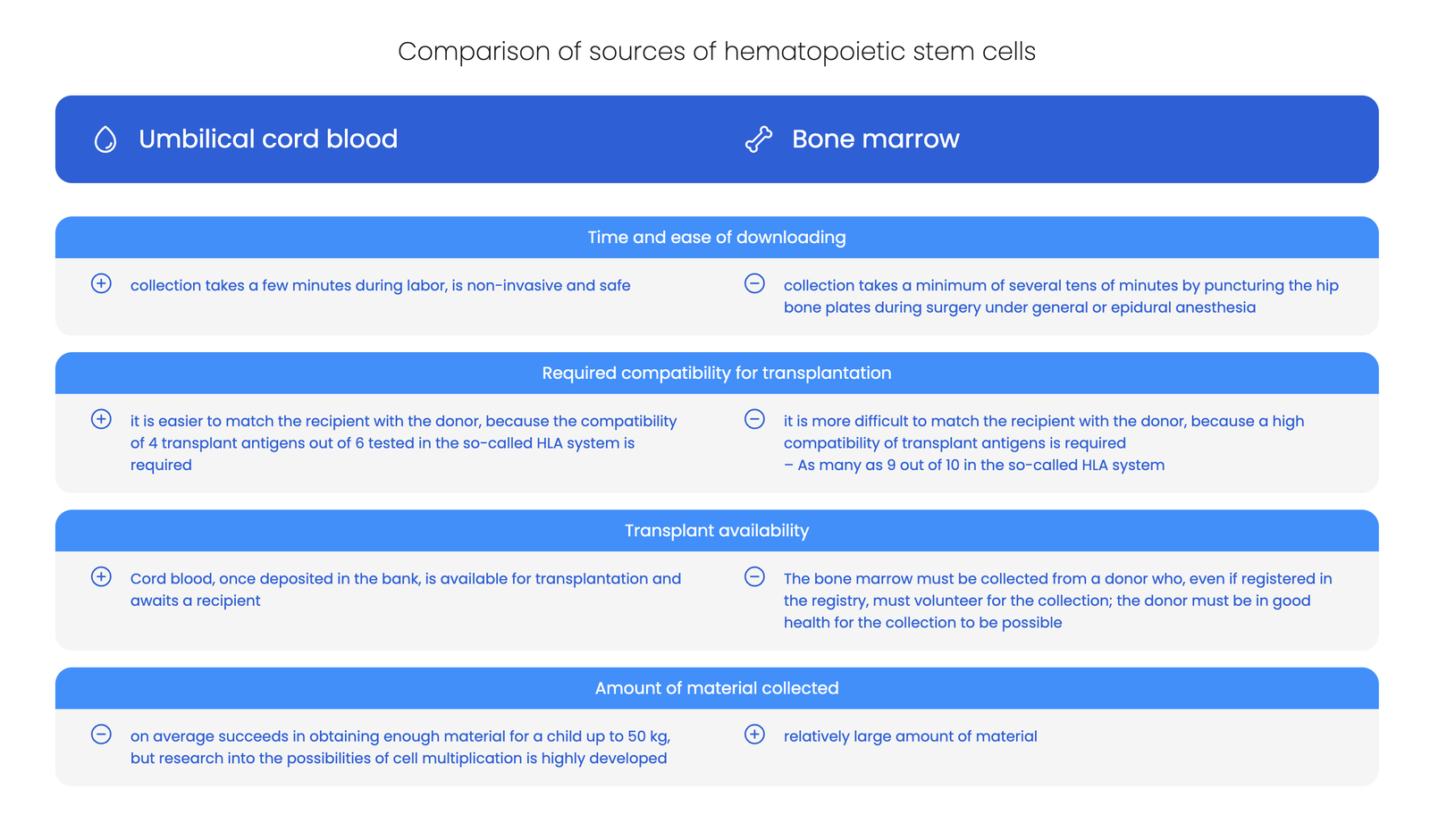
For many years, bone marrow has been the primary source of stem cells, as it is widely available and can be harvested at almost any stage of life. However, a key challenge with bone marrow is the difficulty of finding a compatible donor. For the transplant to be successful, the donor and recipient must match at least 9 out of 10 HLA transplant antigens. This makes finding a suitable donor time-consuming and, in some cases, nearly impossible.
Fortunately, bone marrow is not the only source of stem cells. Stem cells can also be found in umbilical cord blood, which is collected after the birth of a baby. These stem cells are primary and unspecialized, which makes matching the donor and recipient easier. In the case of cord blood stem cells, a match of just 4 out of 6 transplantation antigens is required. However, since cord blood can only be collected once in a lifetime, it is important to consider cord blood banking during pregnancy.
What Is Cord Blood?
Umbilical cord blood is the blood that remains in the umbilical cord and placenta after birth. Previously considered medical “waste,” it is now collected to isolate stem cells for storage and later use in treatment.
Stem cells from collected umbilical cord blood, also known as hematopoietic cells, can be transplanted to rebuild the hematopoietic and immune systems. These cells are often more effective than those obtained from adult donors. Umbilical cord blood stem cells can be used in both autologous transplants (where the donor is also the recipient) and allogeneic transplants (where the recipient receives cells from another person, such as a family member).
Because stem cells from cord blood offer greater efficacy than those from bone marrow, they are increasingly being used in medical treatments, including life-saving procedures. Additionally, by banking cord blood, the time to begin treatment is reduced, as there is no need to search for a compatible donor like in the case of bone marrow transplants. Stem cells collected at birth can be used immediately when needed.